
|
This
procedure means that the Amateur can never complain about not
giving his dogs marks because he has no help. I, of course,
realize that a dog must be exposed to multiple gunners
(doubles, triples and quads) and there is little substitute
for multiple gunners or multiple remote-control bird throwers.
The experience of watching multiple throws, remembering their
marks and dealing with their interaction is best addressed
with the real thing. However, as I have often hinted in
ONLINE, stand alones can be used to advance many marking
skills. This article will describe the 2 major types of stand
alones (roving stand alones and one-place stand alones or send
backs) and how to do them.
General
Procedure and How to Teach
A
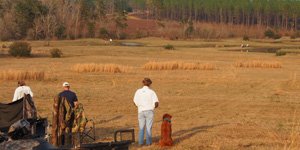
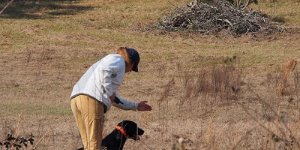
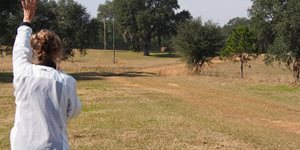
stand-alone mark is one in which the dog sits at the line,
alone, while the trainer walks out into the field (stands
alone) and throws a mark. The dog is ‘released’ with a ‘name’
while the trainer remains at the mark like a gunner/thrower.
When the dog finds the bird he delivers to the trainer.
Stand
alones can be taught to young dogs as soon as they are steady.
This procedure is taught very quickly in one or two sessions,
started in a simple, short cover location. Sit the dog and
walk out about 20 yards. Give a sit whistle and throw a bumper
slightly angled back, watching to be sure your dog remains
steady. Most take responsibility at this distance and watch
the bird down. Some dogs will continue to watch the fall but
others will shift their focus to look at you. In either case,
count 1-1000, 2-1000 and release your dog with his name and a
slight angle-in cast motion (the literal cast for this
retrieve.) When the dog fetches, simply call him, ‘here’,
for the delivery. Young dogs who are going through the yard
basics or transition work at this stage will find this
procedure very familiar from many casting drills.
When
this is cleanly done (often the first time!), increase
distance between you and the dog. I have found this procedure,
if introduced incrementally, is mastered readily at distances
up to 50-100 yards in one or two sessions. Older dogs catch on
very quickly.
Although
this is the basic procedure, there are 2 fundamental types of
stand alones: roving stand alones and one-place stand alones.
Roving
Stand Alones
In
the Roving Stand Alone, the dog is placed at a starting line
as you walk out for your first mark. This may be from 50 to
hundreds of yards. You throw the bird, release the dog, await
the find, then call the dog to you. Then, you leave the dog at
that spot and you move on to the next location and repeat the
sequence. With a large field, you might throw 5-6 marks as you
move around and end up back near the starting point. Every
mark is different and the dog has a different starting point
each time. This is the simplest and most basic type of stand
alone.
One-Place
Stand Alones or Send Backs
This
procedure differs from the roving stand alones in that each
retrieve made by your dog is from the same place (line)
although each mark is different. This means that you must
teach your dog to return to the original line after each
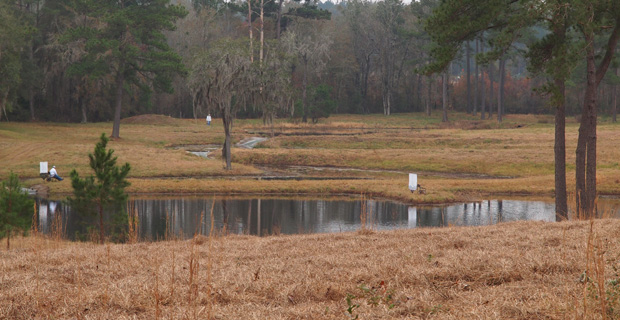
retrieve. A very valuable aid here is the use of a white
marker such as a jug or pail. Long-time ONLINE readers will
know that I rarely advocate use of white jugs in teaching
blinds except perhaps in establishing some early drills.
However, the use of the white marker here is most helpful and
since you will still be doing lots of cold blind retrieves at
other times, your dog will not become dependent on the marker.
The
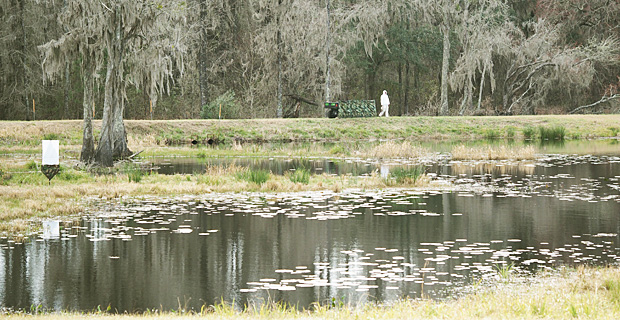
procedure is to locate the line and to place a white marker
prominently. I do this with the dog watching. A simple marker
is to take a white pail and invert it over a shrub at a height
of 3-4 feet. A white jug (e.g., a plastic bleach bottle) on a
pole also works well. When starting a dog, I might even
emphasize the marker to the dog by banging it and saying
watch. Sit your dog and walk out for the first mark. Throw it
and after a pause release your dog. When the dog finds the
bird, have him deliver to you while facing back to the white
marker (which should be visible from your spot.) Line him up,
take the bird and send him back to the marker with a
"back." The dog should line to the pail but handle
if you must to maintain a reasonable line. When he is close
(+/- 2-3 yards) from the marker, stop him with a whistle. With
an eye on your dog, walk to the next mark location as your dog
sits there. Throw the next mark and repeat the procedure. This
can be readily built into a triple or quad very reminiscent of
3-4 walking singles by 1 gunner.
Benefits,
Refinements and Embellishments
Stand
Alones have the benefits of the dog watching a gunner throw a
mark and then retrieving as in a real test or trial situation.
For those that train for UKC HRC events, you can step behind a
tree to be hidden and then throw the mark. The visible gunner
helps the dog to reference the mark and learn the mechanics of
hunting the usual fall area near a gunner.
As
a general rule, I have found that high-rolling dogs who have a
tendency to overrun will more readily check up and establish a
hunt with this procedure. I believe that this is because it is
you standing there and nothing else. A dog is unlikely to run
all over the field because of your "presence." It is
also very easy to quietly say "easy, easy" as your
dog enters the fall area. This, in fact, may help your dog
with gunner awareness. Contrary to what might be expected,
stand alones do not encourage dogs to run towards gunners, in
my experience. In fact, for reasons I do not quite understand,
a steady diet of stand alones helps address this problem of
running at gunners. I have found that dogs that regularly
(2-3x a week) get stand alones, will run wide of guns or
directly at the marks. Part of the explanation may be that as
an "adult" thrower, you can ensure that all throws
are long. The preferred day-in, day-out throw is a long square
one but a huge benefit of stand alones is customized bird
placement. Since you are at the fall location, you get an
excellent opportunity to study your dog’s marking. You can
readily watch your dog’s eyes, ears and posture to determine
exactly when he starts his "look." This is when he
"thinks" he has entered the fall area. You can also
carefully study his hunt pattern. On subsequent throws, you
can adjust the bird placement to work on your dog’s weakness
and tendencies. For example, you may throw angle-in or
angle-back to adjust over-running or hunting short. Dogs who
curl under the arc or fade with the wind can be given extra
long throws to help counter tendencies.
Stand
Alones can employ bumpers, dead birds, shackled birds or even
flyers, if you can shoot yourself. Since you always end up
with the bird you only need one to do a series.
Another
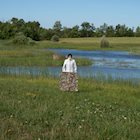
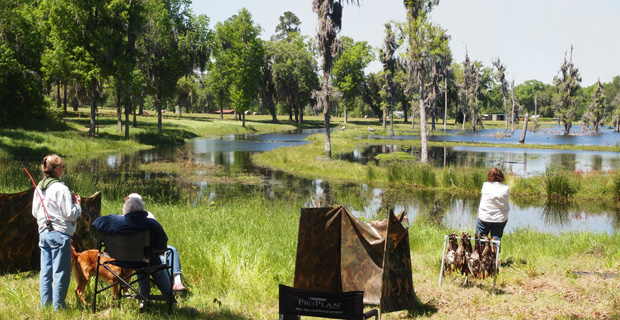
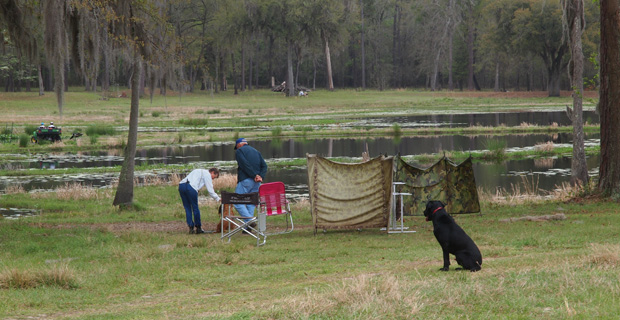
refinement that I regularly do is retire. This can be by lying
down in high cover, stepping behind a tree or often using a
camouflage umbrella and simply squatting behind it. Locations
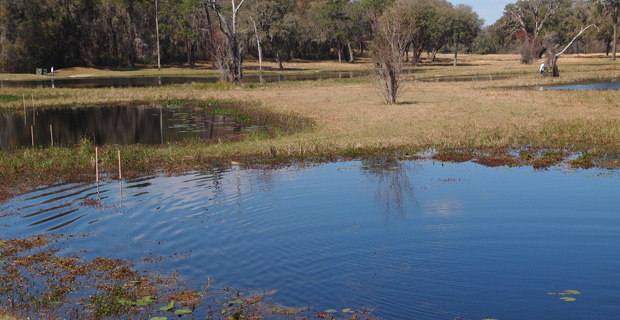
where you can walk around ponds or down shores allow many
water marks and practice on staying in the water. I recommend
that the entry of water marks be non-cheaty since it is
confusing to try and correct for these cleanly. However, it is
reasonable to handle to keep the dog in the water near the end
of marks.
For
roving, but especially one-place stand alones, you can set up
diversions such as white chairs or white stick men in the
field before running your dog. If you want to work on a
concept such as inclines or indents, set up the locations
first with chairs or stick men and use one-place stand alones.
As you move from station to station, the experience your dog
will get is very similar to that from running singles out of a
triple configuration of gunners.
The
return to the marker in one-place stand alones has the
advantage of getting a dog to run a straight line. If your
line to the spot involves factors such as terrain, cover and
wind, this can’t help but be beneficial. Another benefit is
conditioning. In these set-ups, your dog runs every line
twice.
Although
many amateurs have not tried these, those that have have been
very pleased with their benefits.
Try
them!
<return
to sample articles
HOME
|